Knowing the year of construction of a mobile home determines its resale value, the possibilities for installation in campsites, and the actual comfort level of the accommodation. Several methods allow you to find this information, but not all are equal, and the confusion between commercial vintage and year of manufacture regularly traps buyers.
Commercial vintage and year of manufacture of a mobile home: two distinct data points
A mobile home can be sold under a vintage that does not correspond to its factory release date. A model manufactured at the end of the calendar year is often marketed under the vintage of the following year, just like in the automotive industry. The commercial vintage can differ by one year from the actual manufacture, even for recent models.
This distinction has direct consequences when purchasing a used model. A campsite that imposes an age limit (often around fifteen years) is based on the year of manufacture, not on the vintage displayed in the manufacturer’s catalog. A one-year discrepancy can be enough to render a mobile home ineligible for installation.
| Criterion | Commercial vintage | Year of manufacture |
|---|---|---|
| Source | Manufacturer’s catalog, sales brochure | Identification plate, factory invoice |
| Reliability for dating | Indicative | Legal reference |
| Possible discrepancy | +1 year compared to manufacture | None (actual date) |
| Used by campsites | Rarely | Yes, for age limits |
To avoid any dating errors, it is possible to check the manufacture of a mobile home on Immobilier et Particuliers by cross-referencing several documentary sources.

Identification plate and serial number: where to look on the chassis
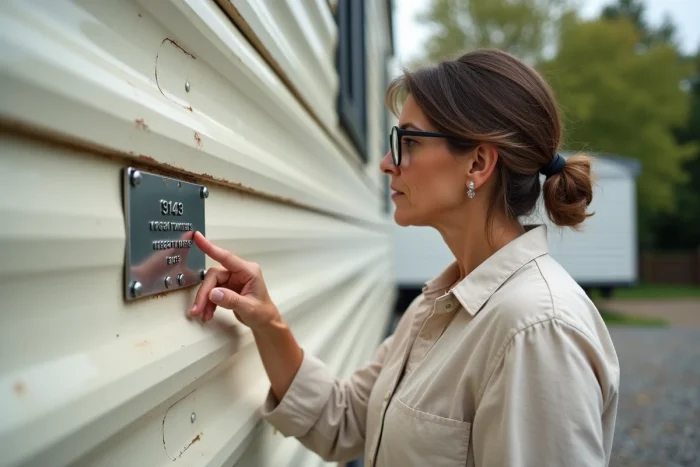
The most direct method remains reading the identification plate fixed to the chassis. This metal plate, riveted or welded, bears an identification code unique to each unit produced. It is usually found in one of these locations:
- On the drawbar (the front part of the chassis, used for towing), often visible without disassembly
- Under the floor, at the leveling plan, which sometimes requires sliding under the structure
- In the technical compartment, near the electrical panel or the entrance door, a location that manufacturers increasingly prefer since 2024
The number engraved on this plate does not directly provide the year of construction. You need to contact the manufacturer (IRM, Trigano, Louisiana, O’Hara, for example) by providing this number to obtain the exact factory release date. Most manufacturers respond by email within a few days.
If the plate has disappeared (corrosion, tearing during transport), the serial number may sometimes be stamped directly into the metal of the chassis. A cleaning with a wire brush can make it reappear.
What to do when the plate is unreadable
On models from before the 2000s, the plate often oxidizes to the point of becoming unreadable. In this case, the original delivery invoice remains the most reliable document. It mentions the date of manufacture, the exact model, and the serial number. The maintenance log, when it exists, complements this information.
Compliance documents and invoices: often overlooked evidence
Competing articles focus on the physical inspection of the chassis, but administrative documents provide a more robust cross-check. Three types of documents are worth searching for:
- The initial purchase invoice, which mentions the date of manufacture and the vintage, sometimes distinctly
- The compliance certificate issued by the manufacturer, which certifies adherence to the standards in effect at the time of production
- The transfer certificate, when purchasing a used model, which includes the information from the identification plate
In the absence of these documents, a written request to the manufacturer with the serial number is sufficient in most cases. Manufacturers keep production records for several decades.

Insulation, chassis, and layouts: visual clues to estimate the manufacturing period
When no document or plate allows for a definitive answer, certain technical elements provide a dating range. The type of insulation used varies according to manufacturing periods and serves as a useful clue.
Mobile homes produced before the mid-2000s primarily used thin glass wool, with a simple uninsulated floor. More recent models incorporate sandwich panels and enhanced floor insulation, sometimes with a centralized heating system.
Other period markers to observe
The chassis itself provides indications. Hot-dip galvanized structures have become common on recent models, while older chassis often feature traditional anti-corrosion paint that chips over time. The type of windows (single or double glazing), the presence of mechanical ventilation, and the style of interior layouts (kitchen arrangement, type of coverings) also help to place a mobile home within a decade.
These clues remain approximate. They serve to detect an inconsistency (a seller claiming a recent model while the insulation and chassis correspond to an earlier generation), not to establish a precise date.
What impact on purchase and campsite installation
The year of construction of a mobile home determines its acceptance by a campsite, its resale value, and its actual comfort level in terms of insulation and heating. An older model costs less to purchase, but its installation on a plot becomes difficult after a certain age, and the costs of upgrading (insulation, carpentry, electrical circuit) can absorb the initial savings.
Before any used purchase, cross-checking between the identification plate, the original invoice, and the manufacturer’s response remains the only method that guarantees reliable dating. The vintage from the commercial catalog is not sufficient.