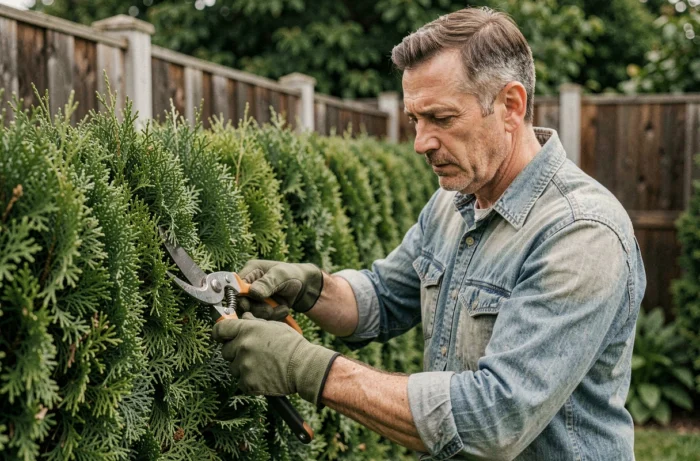
Your thuja hedge is starting to spill over onto the sidewalk or into the neighbor’s yard. You grab the hedge trimmer, and in twenty minutes, the damage is done: a brown strip appears, which will probably never green up again. Thuja does not regrow on old wood, and this particularity changes the entire logic of pruning compared to a privet or a laurel. Knowing when and how to prune thujas prevents this kind of irreversible damage.
The old wood of thuja: understanding what makes pruning risky
On most deciduous shrubs, cutting a bare branch eventually leads to new growth. Thuja works differently. Its branches only bear green scales on their young parts, those exposed to light.
As soon as an inner area is deprived of light for several seasons, it turns brown and loses all capacity for regeneration. Pruning down to the brown wood creates a permanent hole in the hedge. No fertilizer, no watering will correct this mistake.
In practical terms, this means that each pruning pass must stay within the green layer. You can shorten the year’s growth, moderately reduce the thickness of the foliage, but never exceed the visible boundary between green and brown inside the branch. To delve deeper into the subject, check out this guide on when and how to prune thujas.
Thuja pruning schedule: two windows to respect
Have you noticed that your hedge grows mainly between April and July? This is the first flush, the most vigorous. A second, more modest flush occurs at the end of summer. These two growth phases define the times when pruning is most effective.
First pruning: late spring
Wait until the first wave of growth is almost over, usually in June. The hedge has produced its new shoots, and you can shorten them without stressing the tree. The remaining foliage will still have enough warm weeks to heal.
Second pruning: late summer
September pruning tidies up the hedge before winter. It corrects the shoots from the second wave and gives a clean profile for several months. After this date, avoid pruning: thuja gradually enters dormancy, and late cuts expose the branches to frost.
Wildlife protection: a constraint to integrate
The period from March 15 to July 31 corresponds to the nesting of many bird species. The French Office for Biodiversity recommends avoiding hedge pruning during this window. The LPO even extends caution until August 31 for late broods.
Before each pruning, visually inspect the inside of the hedge. Even outside the sensitive period, a nest may be present. The destruction of a nest or eggs of a protected species is punishable regardless of the date, under the Environmental Code.
Trapezoidal shape of thuja: prune narrower at the top than at the bottom
Why this choice? Because light comes from above. If the top of the hedge is as wide as the base, the lower branches receive very little sunlight. They eventually become bare, resulting in a hedge that is dense at the top but hollow at the bottom.
The solution is to give the hedge a slightly trapezoidal profile: the top should be narrower than the base by a few centimeters on each side. This shape ensures that light reaches the entire height of the foliage.
To achieve a uniform result, stretch a string between two stakes at the desired height. It serves as a visual guide and prevents unsightly undulations. On a long hedge, this step makes all the difference between an amateurish result and a clean profile.
Too wide thuja hedge: correct without losing everything
A hedge neglected for several years may have taken on considerable width. The temptation to straighten everything out in one session is strong, but this is precisely the mistake that causes irreversible brown holes.
The method recommended by landscapers is to break the correction into parts:
- Prune one side of the hedge the first year, staying within the green area. Leave the other side intact so that the tree retains enough leaf surface.
- Wait for new shoots to appear on the pruned side before treating the second side, usually the following season.
- If the hedge is also too tall, reduce the height separately, during a third session, to avoid compounding the stress.
Breaking the corrective pruning over two to three seasons preserves density. A thuja that retains enough green foliage continues to photosynthesize normally and produces new shoots to fill in the lightened areas.
Regular maintenance and suitable tools for pruning the hedge
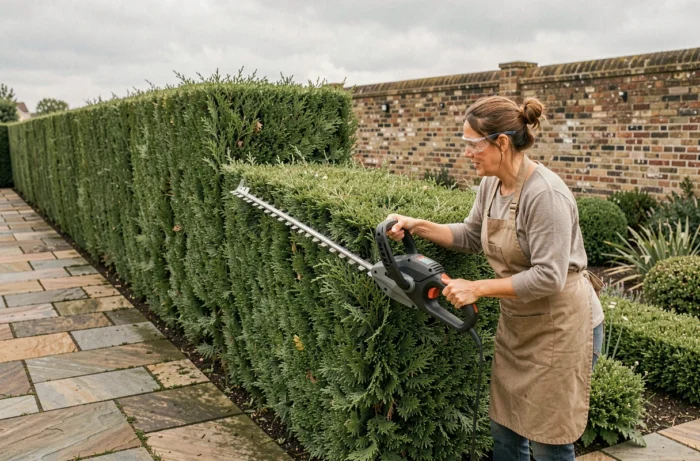
For annual maintenance pruning, an electric or gas hedge trimmer with a sufficiently long blade is suitable for most residential hedges. Thuja branches remain thin on the surface, rarely more than one centimeter in diameter on recent shoots.
Here are some practical tips for effective maintenance:
- Disinfect the blades before and after each use, especially if a neighboring thuja shows signs of disease. 70° alcohol or a diluted bleach solution is sufficient.
- Prune on cloudy days or at the end of the day. Direct sunlight on fresh cuts causes burns on the cut scales.
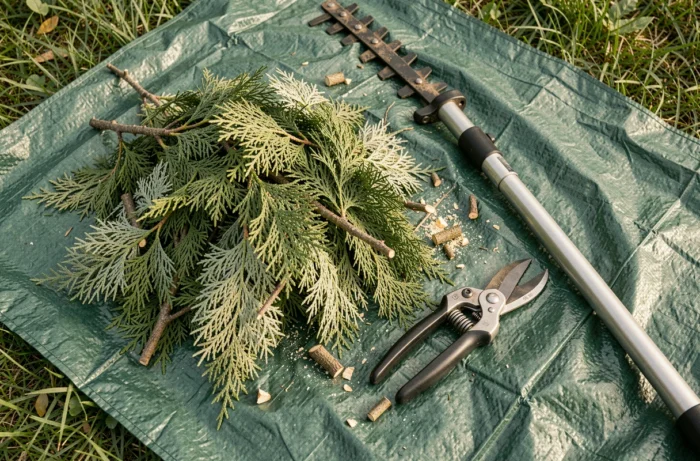
- Systematically collect pruning waste at the foot of the hedge. A pile of dead branches encourages fungi and retains moisture against the trunk.
Clean and sharp blades produce clean cuts that heal better than a tear made by a dull tool. Check the sharpness before each session.
Thuja remains one of the most tolerant conifers in hedges, provided its biological functioning is respected. Regular, moderate pruning, done at the right times and within the green foliage area, is enough to maintain a dense screen for decades. The only truly costly mistake is one that cannot be corrected: cutting into the brown.