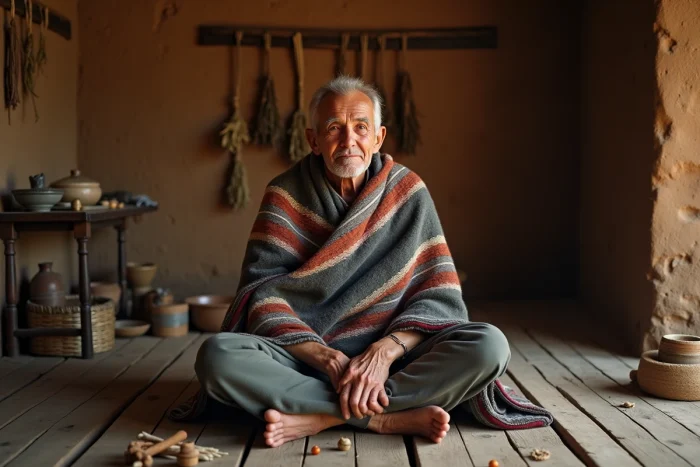
In some societies, extreme psychological distress is not classified as a disorder to be treated, but rather seen as a necessary stage to access a specific role. Anthropologists note that the boundary between illness and vocation is not universal: what is considered pathological elsewhere may constitute a valued initiation here.
Ethnographic surveys confirm this: this phenomenon, far from being marginal, is deeply embedded in collective life. The manifestations, interpretations, and criteria for recognizing shamanic illness vary from group to group. This kaleidoscope of practices reflects distinct visions of health, the sacred, and each individual’s place in the community.
At the origins of shamanic illness: between ancestral heritage and cultural diversity
Shamanism is rooted in a mosaic of contexts: Siberia, the Amazon, Mongolia, Africa, Oceania, Europe. The term “shaman” comes from the Tungusic language, indicating its spread from the steppes of Central Asia. However, the shamanic practice is never confined to a perimeter: it embraces each culture, shapes itself over time, without ever becoming a structured or rigid religion.
The shamanic knowledge, passed down orally, remains a matter of group experience. The shamanic traditions of hunter-gatherer societies testify to this: nature and spirits are present at every stage of the journey. Anthropologist Mircea Eliade emphasized that shamanic illness represents a necessary passage of transformation: the crisis that isolates, causes suffering, but opens the way to the role of mediator between humans and spirits.
The article Understanding Shamanic Illness emphasizes the subtle balance between uniqueness and common traits. Everywhere, the shaman, whether male or female, is defined by their ability to cross the boundaries of the visible, to heal, to watch over the group, and to decode signs. The forms change, the imaginations differ, but a foundation unites these experiences: connection to nature, social role, ritual practices, oral transmission, rejection of dogma. Universal and multiple, shamanism is both a continuation of an ancient heritage and a reflection of the diversity of human societies.
What are the signs and experiences associated with shamanic illness?
The shaman is first recognized through extraordinary experiences, often perceived as crises by those around them. Before being accepted in their role, they go through a period of upheaval, called shamanic illness. This stage manifests through unusual states of consciousness, powerful sensory episodes, recurring dreams, or striking visions. The individual feels cut off from routine: absent appetite, withdrawal, strange bodily sensations, unexplained pains.
Here are the main signs and symptoms noted in many contexts:
- Initiatory visions and dreams: significant encounters with spirit guides, totemic animals, ancestors, or natural powers.
- Altered states of consciousness: episodes of spontaneous trance, loss of the sense of time, feeling of leaving one’s body, heightened sensory acuity.
- Physical and psychological manifestations: persistent fatigue, sudden fevers, agitation, alternating phases of euphoria and deep discouragement.
Trance plays a central role: it is achieved through drumming, singing, dancing, or remedies derived from plants. These rituals open access to an altered state of consciousness and encounters with the spirit world. Certain material signs, such as the discovery of unique natural objects or the presence of symbolic trees (baobab, marula, moringa), reinforce the feeling of being called to a special mission.
The shamanic journey begins here: inner exploration, confrontation with illness, passage to transformation. Gradually, with the help of elders, the person learns to decipher signs, communicate with spirits, and master rituals for the healing of the group and collective balance.

Between spiritual interpretations and contemporary analyses: understanding the multiple faces of shamanism
Shamanism stands at the crossroads of sometimes opposing perspectives. On one side, the living tradition: oral transmission, anchoring in the community, rituals carried by collective memory. On the other, the current scene, with the emergence of neo-shamanism, a modern adaptation that divides opinion. Some find it a space to explore spirituality; others worry about the risks of cultural appropriation or charlatanism.
The sciences no longer ignore these practices. Figures such as Corine Sombrun and Jérémy Narby study shamanic trance, its effects on the brain, and its impact on resilience. International institutions, like the IPCC, recognize the value of indigenous knowledge for the preservation of biodiversity. Thus, the shaman emerges as a bridge between worlds: nature, society, knowledge.
In this context, authors and thinkers, Alessandro Pignocchi, Arnaud Riou, Gilles Wurtz, question the place of shamanism today. Should we see it as a lever for personal transformation? A model to reinvent our relationship with the living? Or conversely, a source of confusion, distanced from ancestral practices? The debate remains open, fueled by the desire to understand, the need for meaning, and vigilance against hasty appropriations.
Shamanic illness, far from being reduced to a simple crisis, illuminates a shifting boundary between suffering and rebirth, between individual trial and collective response. Beneath the surface, it reveals the capacity of societies to transform anomaly into resource, and inner exile into a power to act. Who knows what our time, hungry for meaning, will retain from these paths traversed by others?