
We start the machine, wait for the coffee, and the cup fills barely a third. The usual reflex is to launch a second dose or suspect a limescale problem. In most cases, the short volume of a Tassimo has a more precise explanation, often related to the T DISC itself or the reading of its barcode.
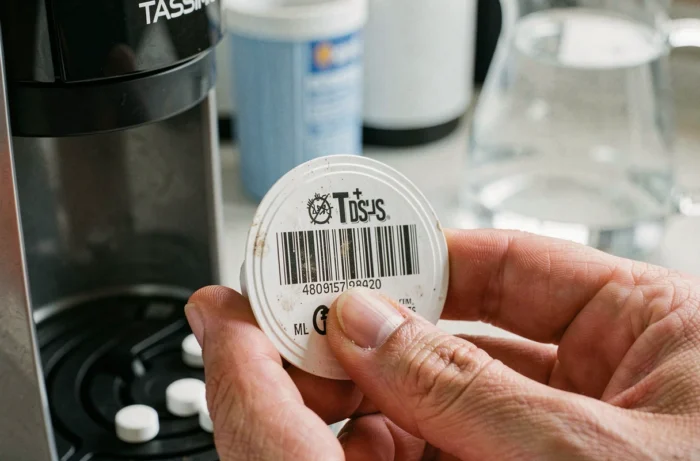
Reading the T DISC barcode: the true driver of volume
On a Tassimo, it is not the user who decides the amount of water. The volume is determined by the barcode printed on each T DISC. The machine scans this code before each preparation to apply the intended recipe: amount of water, temperature, brewing time.
When the barcode is misread, the machine applies a default program, often shorter. Several situations can cause this reading error.
- A crumpled or deformed edge of the T DISC prevents correct positioning in the holder, misaligning the code with the reading window.
- A dried coffee or milk stain on the surface of the barcode distorts the optical reading.
- The reading window itself, located inside the capsule holder, may be dirty from residues accumulated over time.
The simplest diagnostic test is to replace the T DISC with a new, intact one and clean the reading window with a dry cloth. If the volume returns to normal, the problem was indeed with the barcode reading and not the hydraulic circuit.
We often reflexively search why my Tassimo makes small coffees thinking directly of limescale, while this check takes less than a minute and resolves the issue in many cases.
Milk beverage residues and obstruction of the Tassimo circuit
Cappuccinos and lattes leave specific deposits that black coffees do not produce. Milk residues accumulate in the T DISC holder and around the perforation area, gradually reducing the water flow that passes through the capsule.
The result: a shorter coffee, sometimes accompanied by a slower flow. This is not limescale per se, but an organic clogging that acts in the same way on the distributed volume.
Rinsing after each milk beverage
The service disc (yellow T DISC provided with the machine) is precisely for this purpose. It is placed in the capsule holder after each cappuccino or latte, a rinse cycle is initiated, and the hot water dislodges the milk residues before they dry.
If this rinsing has not been done regularly, a more thorough cleaning of the capsule holder is necessary. Remove the holder, rinse it under warm water while gently scrubbing the perforation area with a soft brush, and check that the small holes are not clogged.
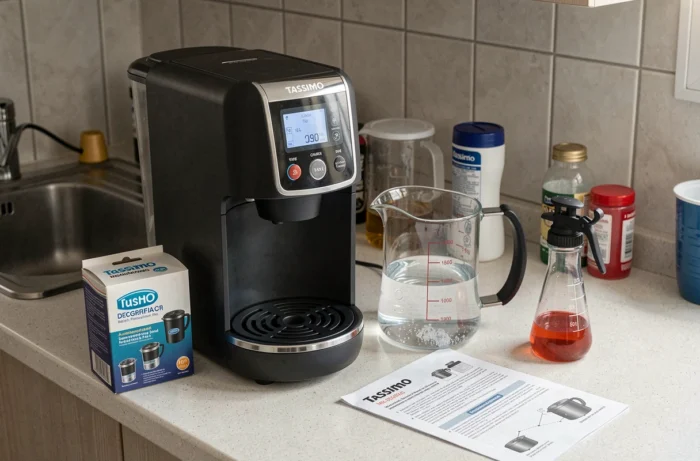
Tassimo descaling: when it really is limescale
Limescale remains a real cause of short coffees, but it rarely occurs alone. A low flow combined with a drink that is less hot than usual suggests internal circuit limescale rather than a simple capsule problem.
Limescale deposits in the pipes and pump, reducing the pressure and the volume of water reaching the cup. On most Tassimo models, a red “calc” light comes on when descaling becomes necessary.
Effective descaling procedure
Insert the service T DISC and start the descaling program. Allow the tablets to dissolve completely before starting the cycle conditions the effectiveness of the treatment.
The cycle lasts several minutes. At the end, rinse the tank and run two to three cycles of clear water to eliminate any chemical residue. If the volume does not improve after a complete descaling, the problem is likely elsewhere.
Tassimo model and volume adjustment: a often overlooked variable
Not all Tassimo models offer the same degree of control over the volume. Some high-end models (like the My Way) allow manual adjustment of the amount of water per drink. On entry-level models (Vivy, Style, Finesse), the machine strictly applies the recipe of the barcode without the possibility of adjustment.
Feedback varies on this point: some users of basic models hold down the preparation button to force an additional amount of water, but this manipulation is not provided by the manufacturer and does not work on all models.
Check the water tank
An insufficiently filled tank or a stuck float can also cause premature stopping of the distribution. Remove the tank, check that the float moves freely, and refill with fresh water above the minimum level.
This check seems basic, but a float stuck by limescale or improper repositioning of the tank after filling are common causes of shortened coffees.
The diagnosis of a short coffee on a Tassimo follows a logic of elimination: first the T DISC and its barcode, then the clogging from milk beverages, then limescale, and finally the tank. Treating the correct cause avoids unnecessarily descaling a machine whose problem is simply a dirty barcode.