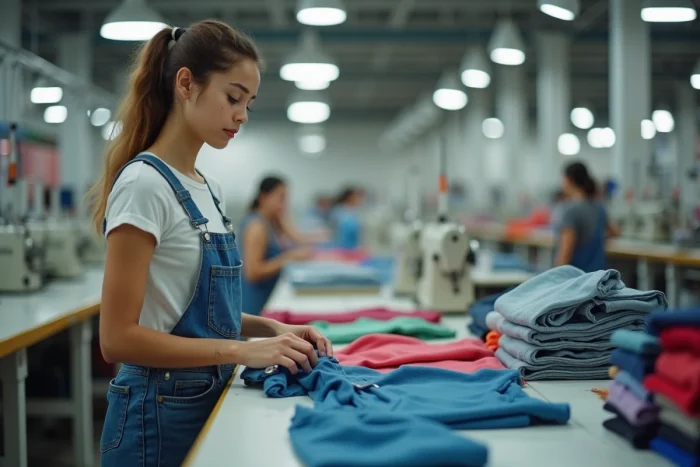
A stark figure, unvarnished: over 90% of the clothing sold at Camaïeu comes from workshops far from the Hexagon. This sets the stage for the new life of the brand, which has reinvented itself on the ruins left by the liquidation of 2022. Behind the renovated storefronts and the storytelling of renewal, the reality of the production chain leaves little room for illusion.
Since the relaunch of Camaïeu in 2023, the majority of the collections are made outside Europe, primarily in Bangladesh, Turkey, and China, according to company data. Suppliers must ensure regular social audits, but some partners still operate in areas where traceability remains partial.
The brand applies a double standard: ethical commitments displayed in France, cost-optimization practices abroad. The subcontracting circuits, sometimes opaque, allow for increased responsiveness but complicate control over the entire supply chain.
Camaïeu: a French brand at a crossroads
The trajectory of Camaïeu embodies the ambiguity of French ready-to-wear confronted with globalization. After the storm of the judicial liquidation in 2022, the brand has come back to life under the direction of new investors, but on a tenuous thread. The stores in France are reopening in waves, supported by a clientele attached to this popular brand, while the market for women’s ready-to-wear undergoes its own transformations.
This return does not come without tensions. Between the weight of a national heritage and the need to remain competitive, the brand is trying to find a balance. The latest reports from the Lille tribunal highlight the size of the challenge: nearly 700 million euros in revenue before the shipwreck, a dense network of points of sale, and an identity forged among generations of customers. Today, the parent company, Modacin Holding Financière, seeks to right the ship under the watchful eye of historical figures like Jean Duforest or Karine Renouil Tiberghien.
For the brand, the challenge is not limited to commercial revival. The collections, designed for everyday life, materialize the tension between the imperative of profitability and the expectations of a clientele more attentive to ethics. Articles on Style Papers decode the complexity of supply chains and shed light on the realities of outsourced production. While the brand cultivates an image of proximity, it must contend with a globalized textile sector that, amid restructuring and economic pressure, is redefining the future of French ready-to-wear.
Where do Camaïeu clothes really come from? Decoding the manufacturing circuits
The production of Camaïeu clothing has largely moved away from French territory. The label “made in France” now applies to only a handful of items. For several seasons, the brand has relied on a vast international network, dominated by workshops in Southeast Asia. Bangladesh, India, China, Turkey: these countries are now the center of gravity for Camaïeu’s textile manufacturing.
The manufacturing circuits are organized around volume and profitability logic. Standard pieces, t-shirts, sweaters, baby clothes, knits, come almost exclusively from subcontracting suppliers based far from Europe. The quest for low prices forces the choice of workshops capable of producing quickly, in large quantities, and at lower costs. This strategy, inspired by fast fashion, accelerates the turnover of collections but makes tracking the supply chain much more complex.
Origin and distribution of production sites
Here is how the main production locations for Camaïeu clothing are currently distributed:
- Bangladesh: majority production of cotton items.
- India: production of knits and baby clothes.
- Turkey and China: assembly, finishing, technical textiles.
The mention “made in France” persists but remains the exception, reserved for a few special series or occasional collaborations. The majority of production now takes place thousands of kilometers away, where labor remains the main lever to keep prices low. This operation illustrates how much the textile sector depends on globalization to fulfill its promises of variety and accessibility, even at the cost of disrupting the historical balance of French ready-to-wear.

Transparency, production conditions, and ethical issues: what traceability reveals
Traceability is gradually becoming a pillar for the textile industry. Like many brands, Camaïeu emphasizes a growing desire for transparency. But the road ahead is long. Customers want to know where their clothes come from, under what conditions they are made, and what their environmental impact is. However, creating an accurate map of production still feels like an uphill battle.
The choice of the fast fashion model makes precise tracking of supply chains particularly challenging. Between the fragmentation of production stages across multiple continents and the multiple layers of subcontracting, oversight becomes less effective. Even when social audits are conducted, they encounter the complexity of subcontracting networks. As for the label “made in France,” it only applies to a tiny part of the range and does not always guarantee entirely national production.
Ethical issues and social responsibility
Several points illustrate the challenges ahead for more responsible production:
- Respect for workers’ rights in partner workshops
- Limiting risks related to child labor and safety
- Considering the ecological footprint at every stage
The pressure from civil society and the commitment of certain NGOs have helped raise standards on paper. But on the ground, reality evolves slowly. Few detailed information circulates regarding the frequency of inspections, wage policies, or concrete advancements. Traceability, from thread to cash register, is built gradually, driven by the vigilance of independent observers and the growing attention of consumers. Nothing is yet completely transparent, but the demand does not wane.
As clothing crosses borders, the label is no longer just a fragment of truth. It remains to be seen whether Camaïeu will manage, in the coming years, to weave a clearer and more assertive narrative about the origin of what we wear every day.