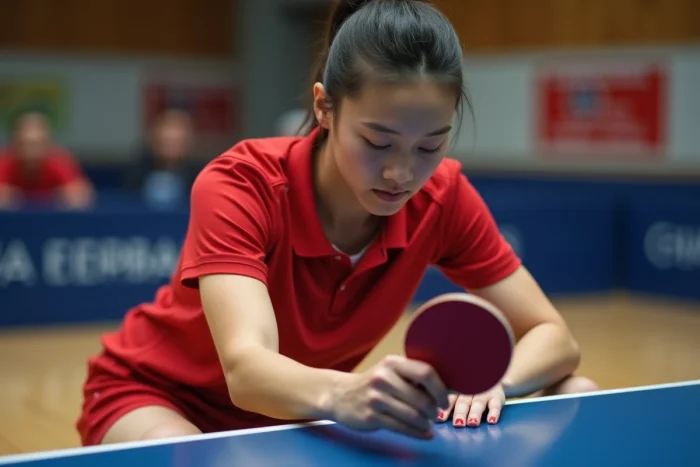
In some table tennis tournaments, referees inspect the length of players’ nails during equipment checks. Experienced competitors refuse to cut them, despite recommendations from coaches and federations. This peculiarity, often overlooked by the general public, leads to debates within clubs and causes confusion among spectators.
High-level players defend this practice by citing technical and psychological advantages. Others see it as a tradition passed down through generations, which persists despite the evolution of the sport and equipment.
An intriguing detail: why do some players have long nails?
In the discreet world of table tennis, one detail catches the eye of connoisseurs: the long nail on the pinky, sometimes meticulously maintained, appears on the hands of many players. Among professionals, this choice is not a fleeting whim. The Lebrun brothers, rising French stars, embrace it openly, claiming this distinctive sign. As the Paris 2024 Olympics approach, the question fuels discussions and exchanges on specialized networks: does this gesture, part ritual and part strategy, hide more than it seems?
Explanations abound and overlap, blending technical aspects and cultural legacies. In the hall, to manage sweat, players use towels or tables, but the long nail sometimes becomes a discreet tool for scratching the ball or adjusting the grip on the racket. Some assert, without folklore or exaggeration, that this detail optimizes grip. Others recall the requirements of the rules, the preservation of equipment, or highlight the role of concentration.
But behind these practical reasons, tradition weighs heavily. Asian influences, African memories: the long nail on the pinky is not just a matter of style. It also signifies the absence of manual labor, asserts a social distinction, or recalls a Réunion identity and codes from China. Aesthetic and symbolic uses then intertwine with the imperatives of the game. To grasp all the reasons for long nails in table tennis, one must navigate between oral tradition, prestige, respect for the game, and silent transmission, all of which enrich the culture surrounding the table.
Between technical tricks and personal rituals: the real reasons behind this practice
For players, the long nail on the pinky is never a mere whim. This habit falls within a dual framework, where pragmatism and aesthetics intertwine. From a technical standpoint, several players assert that a slightly elongated nail refines the sensation when contacting the ball or facilitates micro-adjustments of the racket, especially in the fastest phases of the game. A minor detail? Not for those who seek every nuance that could make a difference.
Some attach a more intimate dimension to this gesture. Maintaining one’s nail then becomes a personal ritual, a way to cultivate concentration and anchor the mind before crucial exchanges. Tapping the table, brushing the ball, repeating this movement: the nail serves as a reference point, a psychological support during the intensity of the match.
The presence of a long nail also evokes, in many countries, the absence of manual labor: an ancient social sign that transcends the simple realm of sport. In Asia, the Chinese tradition once placed great value on fake nails or silver caps, symbols of refinement. In other cultures, this detail distinguishes the initiated from the novice, or even serves to destabilize the opponent by playing on their perception. At the table, the invisible counts as much as the displayed gesture.
What long nails reveal about the psychology and culture of table tennis
The long nail on the pinky among players reveals an unknown facet of table tennis, far from being a mere individual oddity. This custom carries, through the gesture, the depth of a cultural mixing and the mark of a social distinction. In Réunion, some men continue to perpetuate this sign, a product of a heritage blending African and Chinese influences. The nail is no longer just a tool: it embodies an identity, sometimes a mark of prestige, transmitted verbally and silently from generation to generation.
Look closely at the symbolic significance: the long nail evokes refinement, a concern for elegance in gesture, self-mastery. In China, this peculiarity highlighted intellectual activity, far from any manual task. In the world of table tennis, this detail fits within the respect for a codified game. The persistence of the ritual, the attention to the nail, emotional management: all these elements sketch the portrait of a player’s psychology where every detail matters, shapes attitude, and forges confidence.
This trait of uniqueness, far from being anecdotal, illuminates the richness of individual and collective journeys. At the table, one who sports a long nail is part of the continuity of an oral transmission and a dialogue with history. Other cultures, particularly in Africa, also value this sign as a marker of belonging. The respect for the game is then read in this meticulous attention to detail, reminding us that the culture of table tennis is built as much in daily gestures as in the lines of the rules. The game never stops at the ball: it continues, discreet and persistent, right down to the fingertips.